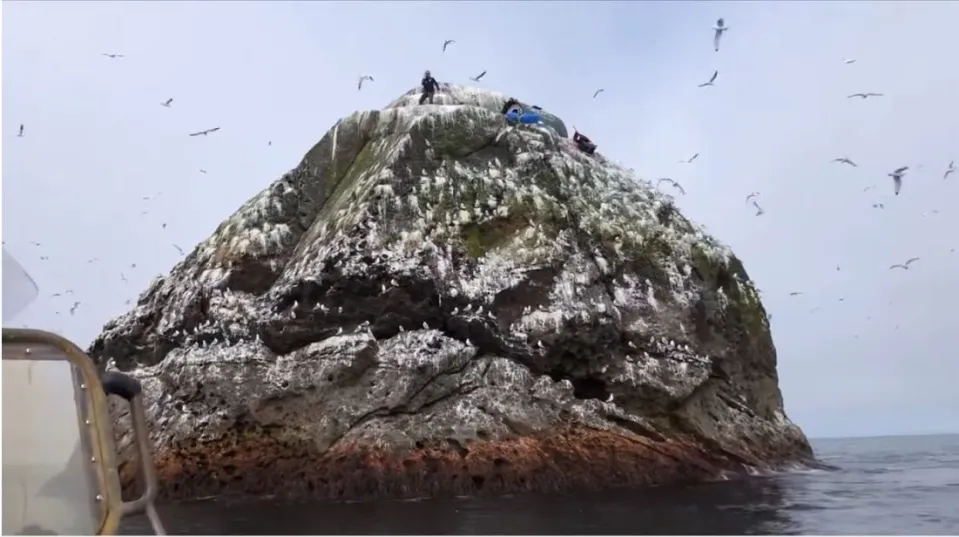
The Wild Citizens of Rockall: Seabirds and Deep-Sea Life on the Edge
The North Atlantic doesn’t just rage against Rockall; it tries to swallow it whole. We stood on the deck of our vessel, watching forty-foot swells detonate against that tiny speck of granite, sending plumes of white water higher than the rock itself. Yet through the telescope, something impossible emerged from the chaos. Thousands of seabirds clung to those wet ledges with a nonchalance that bordered on absurd, preening feathers while the ocean threw everything it had at them. The sound reached us a moment later—not the muted roar of destruction, but a raucous, creaking, living din that cut through the storm. It begged the question that drove our entire production: how does life not just cling on here, but positively shout in the face of the void?
The Granite Magnet: Why Rockall Draws a Crowd
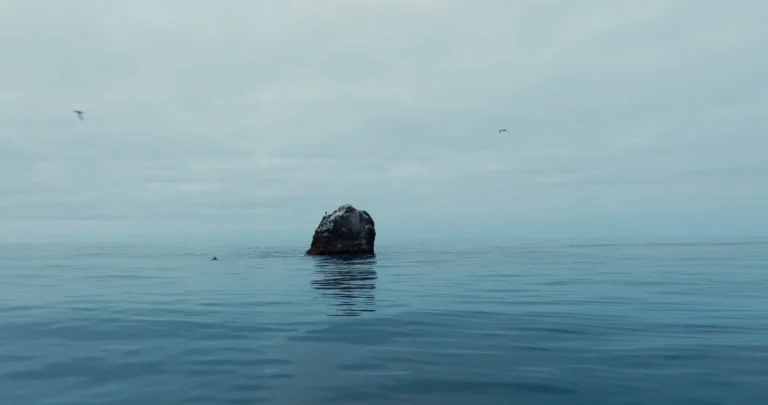
From a distance, Rockall looks like a geological mistake. A lone tooth of granite jabbing out of the ocean 230 miles west of the Outer Hebrides, it represents the last gasp of a long-drowned continent. To the human eye, it’s a navigational hazard. To the marine ecosystem, it’s a lifeline in an oceanic desert. We quickly learned that this isn’t just a rock; it’s a magnet, pulling life from hundreds of miles around into a single, frenetic hub.
A Lonely Pitstop in the Atlantic
To understand the chaos, you need to look at a chart of the North Atlantic and observe the void. The nearest substantial landmass is the St Kilda archipelago, itself a remote outpost lying roughly 190 miles to the east. For birds ranging across the ocean, Rockall provides the only solid ground in a staggering expanse of water. We watched exhausted migrants circling the summit, treating this wave-washed pebble as a five-star hotel simply because it was stationary. It’s a vital rest stop where a tired wing can finally fold, a critical refuge that prevents birds from being swallowed by the relentless swell during a storm.
Upwelling Nutrients: The Invisible Buffet
But a dry rock isn’t enough to sustain a metropolis. The true draw lies beneath the keel. As deep Atlantic currents slam into the steep underwater slopes of the Rockall Bank, they deflect upwards, creating a massive upwelling of nutrients. This phenomenon churns deep-sea minerals toward the sunlight, igniting a bloom of phytoplankton that cascades up the food chain. We filmed dense clouds of zooplankton so thick they stained the water a soupy green. This “invisible buffet” fuels everything from sandeels to mackerel, effectively turning the water column into a feeding frenzy that transforms a barren islet into one of the richest dining spots in the Northeast Atlantic.
Wings Over the Wave: The Gannets and Guillemots
When we finally managed to put camera drones up near the summit—fighting gusts that threatened to dash them against the cliff—we were greeted by a wall of white. The avian residents of Rockall don’t just visit; they own the airspace with a fierce, noisy authority. Our lenses focused primarily on two species that define the character of the rock: the elegant, spear-billed hunters and the crowded, bickering tenants of the lower ledges.
The Gannet Dive: A Spear-Fishing Masterclass
The Northern Gannet is Britain’s largest seabird, a brilliant white cross between an albatross and a fighter jet. Seeing them away from the mainland colonies was a privilege. We filmed them folding their six-foot wings into a swept-back arrow just moments before hitting the water at sixty miles per hour. It’s a high-stakes spearfishing masterclass. Air sacs in their skulls cushion the brain on impact, and we captured incredible footage of them chasing mackerel deep into the green gloom before bobbing back to the surface like feathered corks. The water around Rockall was a constant pincushion of these birds, rising and falling with the swell, utterly indifferent to the towering waves that forced our crew to grip the gunwales.
Guillemot City: Crowded Ledges and Precarious Eggs
If the Gannets are the solo artists, the Common Guillemots are the city dwellers. We observed dense rafts of them on the water, and the lower ledges were jammed shoulder to shoulder with chocolate-brown plumage. The noise here was deafening—a constant, growling “arrr” echoing off the granite. We were particularly fascinated by their breeding strategy, which seems designed by a committee of madmen. The single pear-shaped egg is laid directly onto the bare rock. Its conical shape isn’t a flaw; it’s a genius adaptation that causes the egg to spin in a tight circle rather than roll off the ledge into the sea. Watching parents incubate these precious eggs while salt spray lashed the colony was a masterclass in parental dedication against the odds.
The Hidden Halos: Marine Life Below the Surface
While the birds provide the spectacle, the true soul of Rockall lies in the water column we couldn’t see from the surface. Using specialist underwater camera rigs, we dropped into a world completely hidden from the storm above. The granite doesn’t stop at the waterline; it plunges down into a realm of swaying golds and shocking pinks, revealing a halo of life that is arguably richer than the airborne colony above.
Cold-Water Corals: A Fragile Forest in the Dark
At depths where sunlight fades to a dusky twilight, we found the unexpected: living, vibrant colour. Unlike tropical reefs that rely on warm water, these cold-water corals thrive in the dark, strong currents surrounding the bank. We captured stunning footage of delicate, bone-white branching structures that act as a nursery for juvenile fish. These are ancient, slow-growing forests that take centuries to establish. Seeing them on our monitors, swaying in the deep current, felt like peering into a prehistoric sanctuary. They are the fragile scaffolding of the entire benthic ecosystem, and a single pass of a trawl net could wipe out a millennium of growth in seconds.
Brittle Stars and Wolf Fish: The Bottom Dwellers
On the softer sediment plains beyond the rock, our cameras revealed a moving carpet. Thousands upon thousands of brittle stars—relatives of starfish with delicate, writhing arms—blanketed the seabed, creating a living shag-pile rug. Among them lurked the grumpy-faced architects of the deep: the Wolf Fish. With a face only a mother could love and a set of crushing molars designed to pulverize crabs and sea urchins, this species is a true indicator of a healthy, undisturbed habitat. We filmed one peering out from a crevice, its blue-grey body perfectly camouflaged against the granite, a silent guardian of the deep-water halos.
A Fragile Sanctuary: Conservation on the High Seas
Spending weeks in this environment forced us to confront a difficult truth: this sanctuary is hanging by a thread. The sheer isolation that protects Rockall is no longer a shield against human influence. During our shoot for the Rockall documentary, we couldn’t ignore the signs of a system under pressure, even here, at the very edge of existence.
Protected on Paper: The Reality of Enforcement
Rockall and the surrounding waters fall within a complex web of designations, including a Special Area of Conservation. Organisations like the RSPB and the Marine Conservation Society have campaigned tirelessly to highlight the ecological importance of these offshore sites. However, we saw first-hand the gap between legislation and reality. The distance is simply too vast for regular patrols. We didn’t spot a single fisheries protection vessel during our entire time on station. The birds and corals rely on rules that, out here in international limbo, rely almost entirely on goodwill. It’s a paper park that desperately needs technological monitoring solutions to ensure the rules are respected.
The Plastic Tide: Our Team’s First-Hand Account
Perhaps the most disheartening moment of the expedition came not from the storms, but from a calm, glassy morning. We spotted a vibrant orange dot bobbing near the rock. It wasn’t a rare buoy or a piece of fishing gear; it was a child’s plastic bucket. Inside the bucket, a morose-looking crab had taken up residence, unable to climb the smooth sides to escape. Throughout the shoot, we conducted impromptu beach cleans on our tiny inflatable boat, hauling in:
- Frayed polypropylene ropes and ghost nets that snag on the coral frameworks
- Countless plastic bottles, some with labels so faded they were unreadable
- Microplastics glinting in the surface water samples we collected, invisible to the naked eye until the sun hit them
It was a stark, physical reminder that there is no “away” when you throw something away. The plastic tide reaches even the loneliest rock in the North Atlantic, and the seabirds are mistaking these colourful fragments for food, feeding it to their chicks.
Rockall is not just a lump of granite; it is a living barometer for the North Atlantic. The resilience of the Gannets, the delicate spin of a Guillemot’s egg, and the slow sway of deep-sea corals are all connected to the health of the wider UK marine ecosystem. Standing there, battered by wind and salt, we felt an overwhelming sense of privilege to witness this tenacity of life. We hope that when you see the edge of existence trailer, you’ll feel that same jolt of wonder—and the urgent need to protect it—that we experienced on that tiny, wild frontier.
Frequently Asked Questions
What is the “Rockall documentary” about?
Our film captures the first comprehensive wildlife survey of the islet, focusing on the surprising abundance of life that clings to this remote granite rock. It’s a deep dive into the seabirds and marine ecosystems that thrive in one of the most isolated territories in the UK, exploring how life survives where the Atlantic is at its most violent.
Why is St Kilda mentioned in relation to Rockall?
St Kilda is the nearest major breeding colony and landmass to Rockall, lying roughly 190 miles to the east. It serves as a crucial stepping stone for seabirds like the Northern Gannet that commute to Rockall’s rich feeding grounds, highlighting the ecological link between these isolated Scottish islands.
How can I watch the edge of existence trailer?
The trailer showcasing the dramatic first footage of Rockall’s wildlife is available on our site. It previews the storm-lashed landscapes and the never-before-filmed behaviour of the Atlantic’s most resilient bird colonies and deep-sea creatures.
Is Rockall protected by any conservation bodies?
Yes, the waters around Rockall are designated as a Special Area of Conservation, and groups like the Marine Conservation Society and the RSPB are actively campaigning for better protection. However, due to its extreme remoteness, physical enforcement is incredibly difficult, leaving it vulnerable to illegal fishing and plastic pollution.
What are the main threats to wildlife on Rockall?
During our shoot, the most visible threats were marine plastic pollution and the spectre of unregulated fishing. Climate change also poses a long-term risk by altering the sea temperatures, which could shift the distribution of the sandeels and plankton that the entire food web depends on.